we've probably got the Cold War wrong
& how we could see it from another perspective

My class was recently learning about the Cold War, and I could not help but feel that the syllabus was strangely incomplete. The United States. The Soviet Union. The CIA. The KGB. Domino theory, containment, mutually assured destruction. The narrative seemed almost entirely constructed through the decisions of the superpowers themselves, as though the history of the Cold War was simply the history of two nations competing for ideological dominance. Countries that appeared in between were often introduced only insofar as they became theatres of that rivalry… proxy wars, communist insurgencies, American interventions. Yet the more I sat with this perspective, the more dissatisfied I became. Was the Cold War truly only a story of capitalism versus communism? Or had we become so accustomed to viewing history through Washington and Moscow that we had forgotten to ask what the people caught between them actually wanted?
The case studies I chose to discuss vary considerably. Some involve full-scale armed conflict, while others unfold through covert intervention and political subversion. Yet they all reveal the same underlying pattern: the tendency of Cold War thinking to reduce complex local histories into binary ideological struggles.
In doing so, I hope to invite a broader question about whose perspective our understanding of the Cold War has been built upon.
IRAN (1953)
The Central Intelligence Agency had only been established six years earlier, in July 1947, to coordinate American intelligence and monitor Soviet activities in an increasingly polarised world. Yet as Cold War anxieties deepened, its role expanded far beyond gathering intelligence. Increasingly, it became an instrument of covert intervention, engineering political outcomes abroad whenever governments were perceived to threaten American strategic interests. Iran became one of its earliest and arguably most consequential experiments.
At the centre of the crisis stood Prime Minister Mohammad Mosaddegh, Iran’s democratically elected leader. Contrary to the image later constructed by British and American officials, Mosaddegh was not a communist revolutionary. He was a constitutional nationalist who believed in parliamentary democracy, the rule of law and Iranian sovereignty. His greatest ambition was deceptively simple: that Iran should control its own resources.
This demand centred upon the Anglo-Iranian Oil Company. Although Iranian oil lay beneath Iranian soil, the overwhelming profits flowed to Britain. The company was far more than a private enterprise, it was one of the pillars of British economic recovery after the Second World War and had long supplied the oil that powered the Royal Navy, contributing to Britain’s strategic dominance since the First World War. In 1950 alone, the company reportedly earned almost £200 million in profits while Iran received only around £16 million in royalties. Worse still, Iranian officials were denied access to the company’s financial records, making it impossible to determine whether those payments were even accurate. Mosaddegh initially sought transparency, requesting access to the company’s accounts. When Britain refused, he turned to parliament, which overwhelmingly supported the nationalisation of Iran’s oil industry.
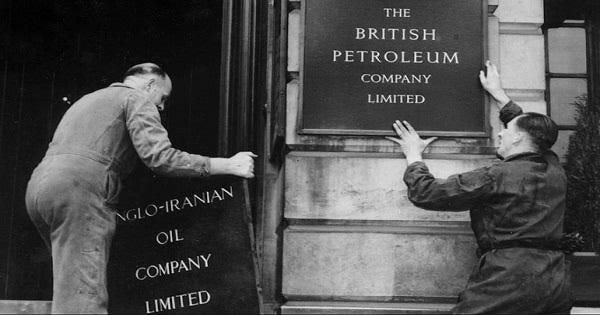
Viewed outside the Cold War, this was an unmistakably anti-colonial movement, one to reclaim economic sovereignty after decades of foreign exploitation. Even the United States initially sympathised with Iran’s position, criticising Britain’s refusal to compromise. It was only after Dwight D. Eisenhower entered the White House in 1953 that Washington’s calculations shifted. British officials successfully argued that continued instability in Iran could allow communist influence to spread southwards. Still, Mosaddegh had repeatedly demonstrated his commitment to constitutional democracy and his distrust of Soviet communism. Even senior American officials privately admitted that he “had no love for the Russians.” His politics were driven by nationalism, not Marxism.
Nevertheless, Operation Ajax, the joint CIA and British operation to remove Mosaddegh bappened. CIA bribed politicians, journalists and military officers, financed newspapers to discredit Mosaddegh, spread propaganda portraying him as anti-Islamic and power-hungry, and organised demonstrations designed to manufacture the appearance of popular opposition. Consequently, Mosaddegh was facing legislative deadlock as monarchists and wealthy landowners repeatedly obstructed his reforms, prompting him to call a referendum seeking public approval to dissolve parliament. Yet rather than allowing Iran’s constitutional crisis to unfold internally, foreign intelligence agencies transformed it into an opportunity for regime change.
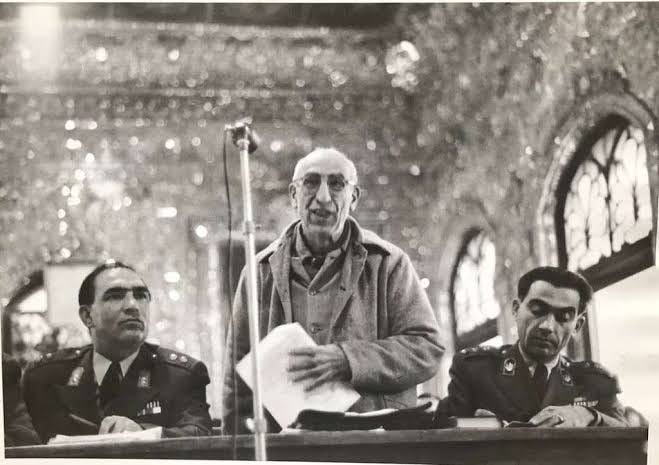
When the first coup attempt failed and the Shah fled the country, American officials briefly considered abandoning the operation. Instead, they redoubled their efforts. The second attempt succeeded. Mosaddegh was arrested, convicted of treason by a military tribunal (see below) and confined under house arrest until his death, while Mohammad Reza Pahlavi returned to the throne with American backing.
The consequences extended far beyond the removal of one prime minister. The coup extinguished what may have been Iran’s most credible opportunity to develop into a secular constitutional democracy independent of both East and West. In its place emerged an increasingly authoritarian monarchy sustained through censorship, political repression and the notorious SAVAK secret police. Secular opposition movements that might have carried forward Mosaddegh’s vision were systematically dismantled. As democratic avenues narrowed, mosques became some of the few remaining spaces where organised opposition could survive. By the time revolution erupted in 1979, the strongest alternative to the Shah was no longer liberal democracy but political Islam under Ayatollah Khomeini.
Revolutions emerge from countless social, economic and religious forces. Yet it is equally difficult to ignore how decisively the coup altered Iran’s political trajectory. By destroying one democratic path, it made other, more radical futures increasingly likely. The anti-Americanism thus grew from the memory of foreign powers overthrowing a government that many Iranians believed genuinely represented them.
Interventions intended to secure stability can, in time, produce precisely the instability they sought to avoid.
VIETNAM CIVIL WAR (1955-1975)
Perhaps nowhere demonstrates this tension between local agency and Cold War ideology more tragically than Vietnam. Today, the Vietnam War is almost instinctively remembered as one of the defining proxy wars of the Cold War (US dropped 7.5 million tons of bombs across Viet, Laos and Cambodia, that is more than was dropped in all of WWII btw), a battle between American capitalism and Soviet-backed communism. Yet to begin the story there is already to misunderstand it. Before it became America’s war, it was Vietnam’s. Long before Washington feared the “domino theory” or Moscow sought to expand its sphere of influence, Vietnamese nationalists had spent decades resisting French colonial rule. Their primary aspiration was not to become another front in a global ideological struggle, but to reclaim a nation that had spent almost a century under foreign domination.
Ho Chi Minh, the great revolutionary! History often remembers him as a communist leader, yet he was equally a nationalist. When he proclaimed Vietnam’s independence in September 1945, he deliberately echoed the opening words of the American Declaration of Independence: “All men are created equal.” He wrote repeatedly to President Harry Truman, hoping that the United States, having itself fought against colonial rule, would support Vietnamese self-determination. Those appeals went unanswered, as US prioritized keeping the French allies (as part of a greater fight against communism). As the Cold War hardened, American policymakers no longer viewed Vietnam primarily through the lens of decolonisation but through the fear of communist expansion. Vietnamese nationalism became inseparable from communism in Washington’s eyes.
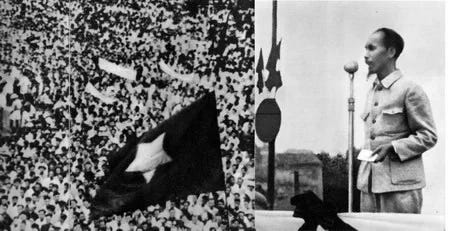
This transformation fundamentally altered the course of Vietnamese history. Under the 1954 Geneva Accords, Vietnam was temporarily divided along the seventeenth parallel, with nationwide elections scheduled for 1956 to reunify the country. Few doubted what the outcome would be. Even President Dwight Eisenhower later acknowledged that Ho Chi Minh would likely have won as much as eighty per cent of the popular vote had genuinely free elections been held. Rather than permit that democratic process, the United States supported the government of Ngo Dinh Diem in South Vietnam, providing extensive financial assistance, intelligence support and political backing while the promised elections quietly disappeared. Once again, Cold War priorities superseded national self-determination. The central question ceased to be what the Vietnamese people wanted and instead became what outcome best served the global strategy of containing communism.
As American involvement deepened throughout the 1960s, Vietnam increasingly became a theatre in which superpowers competed for ideological credibility. The United States committed over half a million troops at the height of the war, while the Soviet Union and China poured weapons, advisers and economic aid into North Vietnam. Yet it was ordinary Vietnamese civilians who paid the overwhelming price. Between two and three million Vietnamese civilians and soldiers lost their lives, alongside approximately 58,000 American servicemen. Millions more were displaced from their homes. Entire villages disappeared beneath aerial bombardment. More bombs were dropped on Vietnam, Laos and Cambodia than had been used during the entirety of the Second World War. The widespread deployment of chemical defoliants such as Agent Orange left forests devastated, contaminated agricultural land and continues to cause birth defects and illnesses across generations. Even after the fighting ended, unexploded ordnance continued to kill and maim civilians decades later. More importantly, this independent nation lost out on three decades which could have been dedicated to building institutions, industrializing and growing economically to war.
For many Vietnamese families, the Cold War never truly ended in 1975; its consequences remain embedded within both the landscape and memory of the nation.
Many Vietnamese fought because they believed they were defending independence, reunification or their own vision for their country’s future. Every military escalation became another test of American credibility; every communist victory became another perceived Soviet success. The lives of millions became entangled in calculations made thousands of kilometres away, where preserving geopolitical influence often took precedence over finding a political settlement that reflected Vietnamese realities.
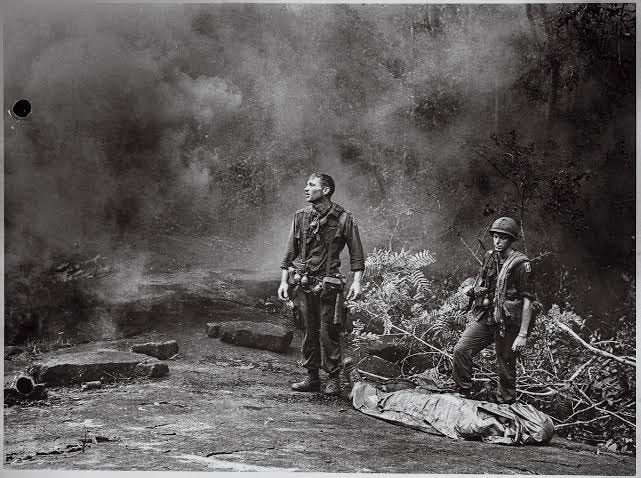
The Vietnamese were never merely proxies. They possessed their own histories, ambitions and vision for their nation long before the United States or the Soviet Union transformed their homeland into one of the bloodiest battlegrounds of the twentieth century.
GUATAMALA (1954)
The story of Guatemala did not begin with communism. It began with land.
By the mid-twentieth century, Guatemala was one of the most unequal societies in Latin America. Approximately two per cent of landowners controlled nearly seventy per cent of the country’s arable land, while hundreds of thousands of indigenous Maya peasants either owned no land at all or survived on plots too small to sustain their families. This was not simply an economic problem but the legacy of decades of authoritarian governments that had privileged export agriculture and foreign investment over domestic development. Following the democratic revolution of 1944, many Guatemalans hoped that political liberalisation would finally be accompanied by meaningful social reform. For the first time in modern Guatemalan history, elected governments began introducing labour rights, educational expansion and constitutional protections not to dismantle capitalism, but to create a more equitable society within it.
When Jacobo Árbenz assumed the presidency in 1951, he inherited these aspirations. Far from advocating a Soviet-style planned economy, Árbenz envisioned transforming Guatemala into a modern capitalist nation no longer dependent upon foreign corporations and vast landed elites. The obstacle, however, lay in the extraordinary concentration of land ownership. His solution, Decree 900, authorised the expropriation of uncultivated estates in exchange for government compensation before redistributing that land to impoverished peasants. To many Guatemalans, particularly rural farmers, this represented the fulfilment of the democratic revolution, a long-overdue correction of historical injustice rather than an ideological revolution.
Yet the very reforms celebrated domestically appeared deeply alarming from Washington. Among the largest landowners affected was the United Fruit Company, an American corporation that owned hundreds of thousands of acres across Guatemala, much of it left deliberately uncultivated for commercial flexibility. More significantly, the company occupied an extraordinary position within both Guatemala and the United States. It controlled railways, ports and communications infrastructure while maintaining close political connections in Washington. Secretary of State John Foster Dulles and CIA Director Allen Dulles had both previously worked for legal firms representing United Fruit, while the company mounted an extensive lobbying campaign portraying Árbenz as another communist threat emerging within the Western Hemisphere. Whether these personal connections directly determined American policy remains debated among historians. What is less disputed is that United Fruit successfully reframed an agrarian dispute into a Cold War crisis.
Unlike Iran, Guatemala did possess a small but genuine communist movement. The Guatemalan Party of Labour operated legally, several of its members advised the Árbenz government and communist politicians openly supported land redistribution. These facts genuinely concerned American policymakers already traumatised by the communist victory in China, the Soviet acquisition of nuclear weapons and the Korean War. Within this broader international context, Guatemala appeared to many officials as another potential domino that, if allowed to fall, might encourage similar left-wing movements throughout Latin America.
But the existence of communist participation within a democratic coalition is fundamentally different from the existence of a communist state. Árbenz himself was never a member of the communist party, nor has convincing evidence emerged that he intended to transform Guatemala into a Soviet satellite. Even the Soviet Union paid remarkably little attention to Guatemala. Unlike later Cold War crises such as Cuba or Vietnam, Moscow contributed virtually no military presence, offered minimal economic assistance and exercised little meaningful influence over Guatemalan policymaking. Indeed, Guatemala’s famous purchase of Czech weapons in 1954 occurred only after the United States had embargoed conventional arms sales, leaving Árbenz with few alternative suppliers. To many historians, this suggests that Washington increasingly interpreted any assertion of economic nationalism through an ideological framework that allowed little distinction between moderate reformism and revolutionary communism.
The United States eventually concluded that the question itself posed an unacceptable strategic risk. Through Operation PBSUCCESS, the CIA therefore sought not merely to remove one president but to eliminate what policymakers perceived as the possibility of communist influence taking root within a democratic system. They did it this time, not with overwhelming military. But psychological reports, fake radio stations and troop movements that eventually convinced the Guatamalan army that they are facing inevitable doom, surrendering. Following that, Arbenz resigned and was replaced by Colonel Carlos Castillos Armas (CIA backed military dictator).
Ironically, in doing so, they also eliminated the possibility of discovering whether Guatemala’s constitutional institutions were capable of resolving these ideological tensions peacefully themselves. Guatemala entered 36 years of civil war starting this coup. Around 80% of indigenous Maya were killed, amounting to 200,000 deaths. UN truth report later concluded that the state forced committed acts of genocides against Maya communities. :(
PAUSE!
OKAY. Up until this point, one could argue that the United States was not acting out of mere aggression, but according to what its policymakers genuinely believed was necessary to preserve the international order. At the height of McCarthyism and following the expansion of communist governments in Eastern Europe, China and Korea, fear of communist influence was not an irrational concern within the American political imagination. From Washington’s perspective, covert interventions were preventative measures designed to contain a global ideological threat before it could spread further.
Yet this justification reveals the very contradiction at the heart of Cold War intervention. Even setting aside the uncomfortable reality that economic interests often intertwined with anti-communist rhetoric… particularly when governments threatened American access to valuable resources, the greater question remains: what does it mean to defend democracy by undermining it? If a country democratically elects a government that aligns with communist ideology, does another nation possess the right to overturn that choice in the name of protecting democracy itself?
The irony is that many of the governments targeted by American intervention were not Soviet-controlled regimes seeking to dismantle democracy, but nationalist movements pursuing their own visions of economic independence and social reform. Yet even if these governments had genuinely embraced communism, the Cold War raised a fundamental ethical dilemma: can the preservation of one ideological vision of freedom justify denying another society the freedom to determine its own political future?
Chile (1973)
Salvador Allende was openly a Marxist socialist.
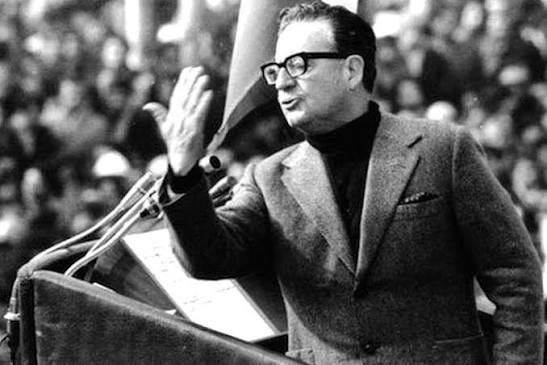
He did seek to transform Chile’s economic system and reduce foreign influence over Chilean resources. Yet the central contradiction of Chile lies precisely here: Allende was not a revolutionary who seized power through violence. He was elected through Chile’s democratic institutions.
Similar to Guatemala, wealth was concentrated among a small elite, rural workers faced poverty and landlessness, and foreign corporations, particularly American companies, held significant influence over key industries, especially copper, Chile’s most valuable natural resource. The Christian Democrats pursued moderate reforms through capitalism, while the socialist and communist parties advocated deeper structural transformation. Within this context emerged Salvador Allende, a physician and longtime socialist politician who had unsuccessfully run for president several times before finally winning in 1970 as the candidate of the Popular Unity coalition.
Allende’s victory was historically significant because he became the world’s first Marxist politician to achieve power through free elections and attempt to construct socialism through democratic institutions. His programme, known as the “Chilean road to socialism,” sought to nationalise major industries, expand social welfare, increase workers’ rights and redistribute wealth while maintaining elections, constitutional procedures and political freedoms. For many Chileans, particularly workers and the poor, Allende represented the possibility that economic inequality could be addressed without abandoning democracy.
However, from Washington’s perspective, Chile represented a dangerous precedent. A Marxist government that came to power through elections posed a challenge to one of America’s central arguments… that communism and democracy were fundamentally incompatible. If Allende’s government succeeded economically and politically, American policymakers feared that other countries in Latin America might follow a similar path. The United States had recently experienced the Cuban Revolution, where a nationalist movement had eventually aligned itself with the Soviet Union. Policymakers worried that Chile could become “another Cuba” in the Western Hemisphere.
Nevertheless, the Nixon administration decided that Allende’s government represented an unacceptable threat. President Richard Nixon and National Security Adviser Henry Kissinger viewed preventing Chile’s socialist experiment as a major Cold War priority. Declassified documents later revealed that Nixon ordered efforts to prevent Allende from taking office and authorised covert operations designed to destabilise Chilean politics. The CIA funded opposition groups, supported anti-Allende media campaigns and attempted to encourage political and military resistance.
One of the earliest efforts was known as Track II, an operation designed to encourage the Chilean military to intervene before Allende could assume office. The CIA supported contacts with Chilean military figures, including General René Schneider, the commander-in-chief of the Chilean Army, who strongly believed that the military had a constitutional duty to remain politically neutral. In 1970, right-wing conspirators attempted to kidnap Schneider, believing that removing him would encourage military intervention. The kidnapping attempt resulted in Schneider’s death, further destabilising Chile’s political environment.
After Allende took office, the United States continued efforts to weaken his government. Washington applied economic pressure, including restricting financial assistance and encouraging international institutions to limit lending to Chile. Internally, Chile also faced severe economic problems. Inflation rose dramatically, shortages increased and political polarisation intensified. Historians continue to debate how much of this economic crisis resulted from Allende’s own policies, structural weaknesses within Chilean society or external pressure from the United States. The reality was likely a combination of all three.
On 11 September 1973, Chile’s military launched a coup led by General Augusto Pinochet. The presidential palace, La Moneda, was bombed, and Allende died during the attack.
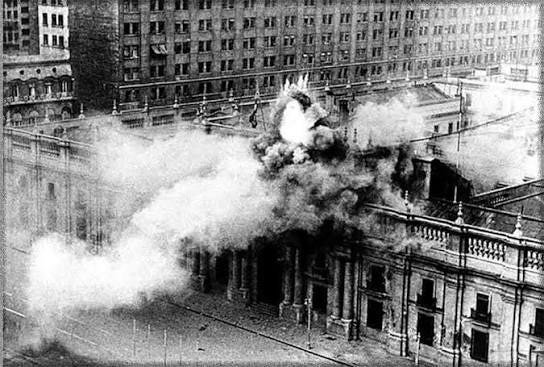
Pinochet established a military dictatorship that lasted for seventeen years. Under his rule, thousands of Chileans were imprisoned, tortured, disappeared or forced into exile. Political parties were banned, civil liberties were suspended and Chile’s democratic institutions were dismantled. A country with one of Latin America’s strongest democratic traditions was transformed into an authoritarian state because Cold War logic had prioritised ideological alignment over constitutional sovereignty.
Unlike Iran, where American policymakers mistakenly equated nationalism with communism, or Guatemala, where social reform was interpreted as revolutionary threat, Chile demonstrates an even deeper paradox: even when a country genuinely chose a socialist path through democratic means, Cold War thinking treated that choice itself as unacceptable.
In attempting to prevent the spread of authoritarian communism, the United States supported authoritarian anti-communism.
Last thoughts…
The histories of Iran, Guatemala, Vietnam and Chile reveal that the greatest consequence of Cold War intervention was not merely the individual wars, coups or political crises that followed, but the way it transformed the futures of nations into battlegrounds for a conflict they did not create. These societies were not empty spaces waiting to be claimed by American democracy or Soviet communism. They contained their own histories of colonialism, inequality, nationalism and aspirations for change long before the superpowers arrived. Yet once viewed through the binary logic of the Cold War, their struggles became simplified into ideological victories and defeats rather than complex questions of sovereignty and self-determination.
They were absorbed into a global ideological contest that neither side had chosen, where the priorities of the superpowers frequently overshadowed the aspirations of the nations themselves.
edit: i realised only after writing this that this seems concerningly biased… overwhelmingly critcising CI
nice one ziyi