no, you aren't bisexual
someone HAS to say it

I have spent an embarrassing amount of time trying to pinpoint, articulate and pen down the very specific kind of irritation I feel watching a straight girl tag her TikTok lipsync with #wlw. I don’t think it’s anger actually, probably disgust.
This is not a piece of writing about hating the queer community. If anything, it is the opposite, because I am really also articulating the voices of my LGBTQ friends and mutuals who have echoed these exact sentiments. The community fought actual battles, whether legal, social or physical for the right to exist openly.
Yet, what we are watching now, across pop music, social media and the dating landscape is a slow colonization of that hard-won space by people who want the aesthetic without the adversity.
Sabrina Carptenter… Being Queer-Adjacent
The “House Tour” music video dropped earlier this week, and very honestly, I found it fun. Sabrina Carpenter robs a mansion with Madelyn Cline and Margaret Qualley, all three of them dressed immaculately. There’s a stolen Grammy. There is a tarantula. They are clearly having a blast.
There is also, unmistakably, a flirtatious charge between the three. None of the three women have claimed to be queer. Sabrina Carpenter, in fact, has pretty explicitly identified as straight. And yet, the video is clearly lit and directed to fell, if not sexual, then at least adjacent to sexual between the women. It makes you wonder. It makes a certain audience feel seen, and then to stop just short of actually seeing them.
This is the new queerbaiting.
The original meaning of the term referred to a media industry tactic. Showrunners who would write two male characters with unmistakable romantic tension, deny it in interviews, and cash in on the resulting fan speculation without ever committing to the representation. The practice was intended to attract queer or straight ally audiences with the suggestion of queer relationships, while not alienating homophobic members of the audience or censors by explicitly portraying those relationships. It was a calculated hedge: get the queer audience's money and attention, give them nothing real in return.
What Sabrina Carpenter does is a more personal and arguably more insidious version. She is not a showrunner. She is a person, which means accusations of queerbaiting get complicated quickly, because we can’t know anyone’s sexuality, the closet is real, nobody owes anybody a coming-out announcement. These are all fair points. But there is a distinction worth making, and it runs through the centre of all of this: there is a difference between an artist who is queer and chooses not to label herself, and an artist who isn’t queer and keeps gesturing at queerness anyway because it’s profitable and aesthetically interesting right now.
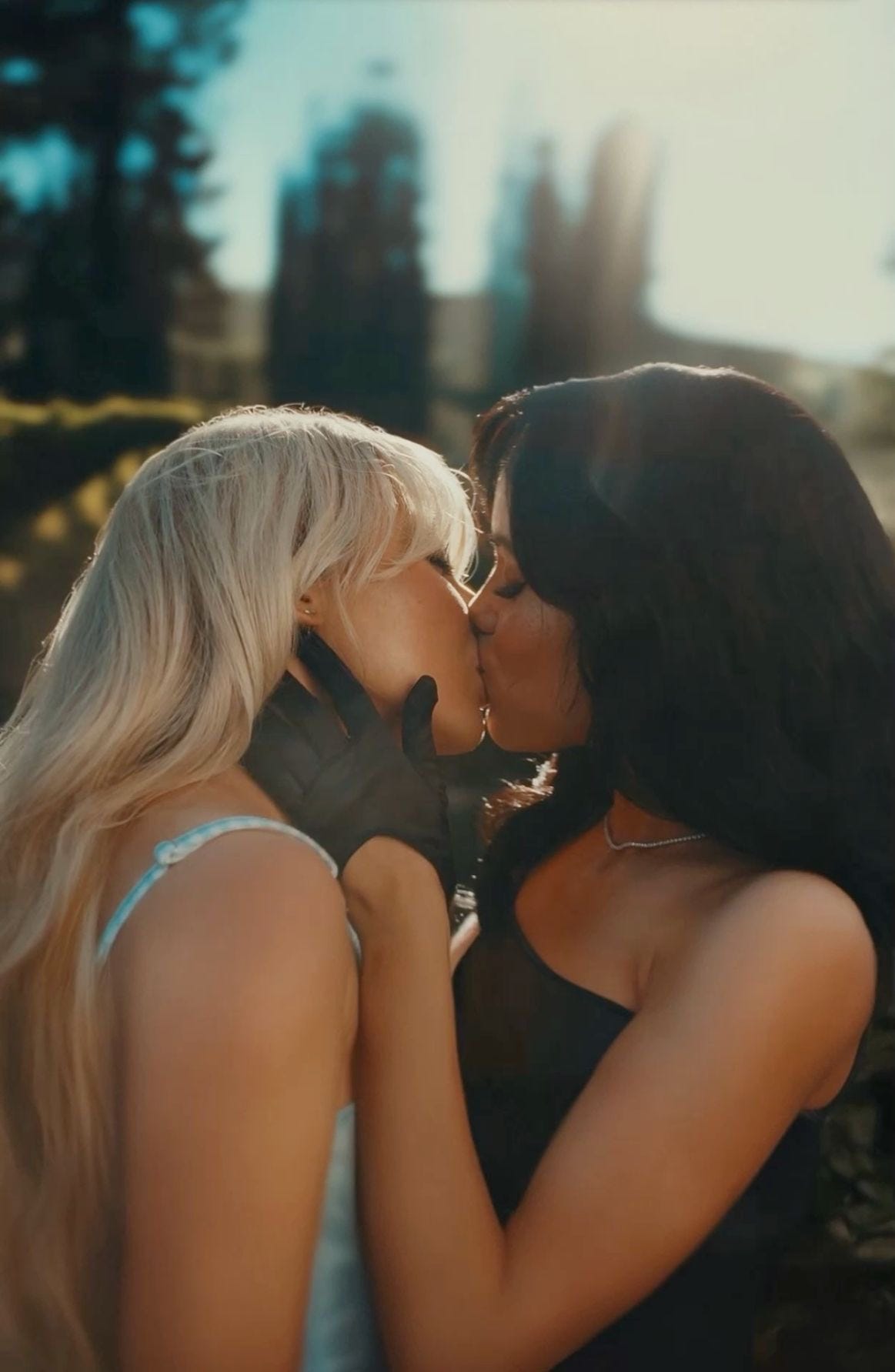
The “Taste” video from last year made this even more explicit: Carpenter appeared kissing Jenna Ortega in a video that mixed horror film references with a plot that ultimately centred on two women’s rivalry over the same man, before they set aside their differences and kissed at the end. The kiss, in that context, functions as a punchline, a twist, a spectacle, not as a genuine depiction of female desire. It’s queer-flavoured content made for a straight gaze, including, importantly, the straight male gaze that has always found two women kissing titillating precisely because it poses no threat to the existing order.
So… if Sabrina isn’t queer, what is it? Heteropessimism, coined in 2019 by writer Asa Seresin describes the attitude of disappointment, embarrassment, or despair at the state of heterosexual relations. It is the “boyfriends are embarrassing… but I have one” energy. Very ironically, it depicts a love hate relationship, centering men.
Sabrina Carpenter’s persona is essentially that. Her whole brand is built around men being somewhat disappointing — “I think I’ve got a cuter word for it! Manchild!”. She is always the too-smart-for-him girl, the one who knows she's too good for this, the one who sings about men with a kind of fond, very fond, exasperation.
Being queer-friendly is not the same as being queer representation. Showing up to perform a set flanked by drag queens… lovely! Genuinely staging your music videos to imply you might be bisexual when you are not… less lovely, actually.
The #WLW pipeline
The hashtag #wlw, has, on Tiktok, somewhere in the region of 32.9 million posts. It was designed as a community tag, a way for queer women to find eachother, to carve out a corner of a very large, very chaotic platform.
And then the algorithm got involved, and some people noticed that posts tagged #wlw do well… they get views. They get a specific kind of engaged, loyal audience. They create parasocial intimacy quick. And so the tag began to fill up with content from girls who are, frankly straight, or at minimum, girls who spend 95% of their emotional and romantic energy on men, but who have developed what I can only describe as strategic girl-curls on someone famous and have decided this counts. There's a version of this that is genuinely exploratory. Young women figuring out their sexuality, using online community to process attraction they don't yet have language for, because that is exactly what these spaces were built for, and it would be cruel to police that. But there is also a version that is purely parasocial and purely algorithmic. A girl who calls Alyssa Liu her “wife” in comment sections, post thirst content about female celebs, tags it “wlw” and proceed to go to sleep thinking about her situationship with a guy. Thats performativity at best, queerbaiting if we are being honest.
The reason this matters is not about hurt feelings. It's about dilution, even though sure it is reaching a larger audience, its great for representation. When the tag that queer women use to find each other gets flooded with content from people who are not actually queer women, the community's tool stops working. The safe space stops being safe. The algorithm starts serving queer content to an audience that doesn't need it, while the people who do need it struggle to filter through the noise. It is a small harm, perhaps, but it compounds.
There is also something very offensive about the underlying assumption here, which is that female same-sex attraction is like an upgrade from heterosexuality. Because, it’s cooler, more aesthetically pleasing, moodier. It really suggests that straight women can try it on temporarily when men are being annoying. This is, again, heteropessimism in action. Straight women have increasingly used this kind of performance as a way to nominally distance themselves from the problem arising in heterosexual relations without doing anything to resolve these problems, meanwhile ignoring straight privilege and oversimplifying the queer experience as being “cooler” and “easier’”. This non-struggle, this fantastical experience is an insult.
The Performative Male and The Performative… oops can’t say it
Now we arrive at the most socially treacherous section.
You now the guy. He carries a tote bag, probably one with a bookshop logo on it, or something from like a NewYork art exhibit. He drinks matcha, specifically. He listens to Claire and Laufey and has super strong opinions about maybe Sally Rooney. He might, casually drop a hint or two about being “kind of bi”, or “against labels” then immediately refrain from further discussions, because he will get exposed if the discussion carries on further.
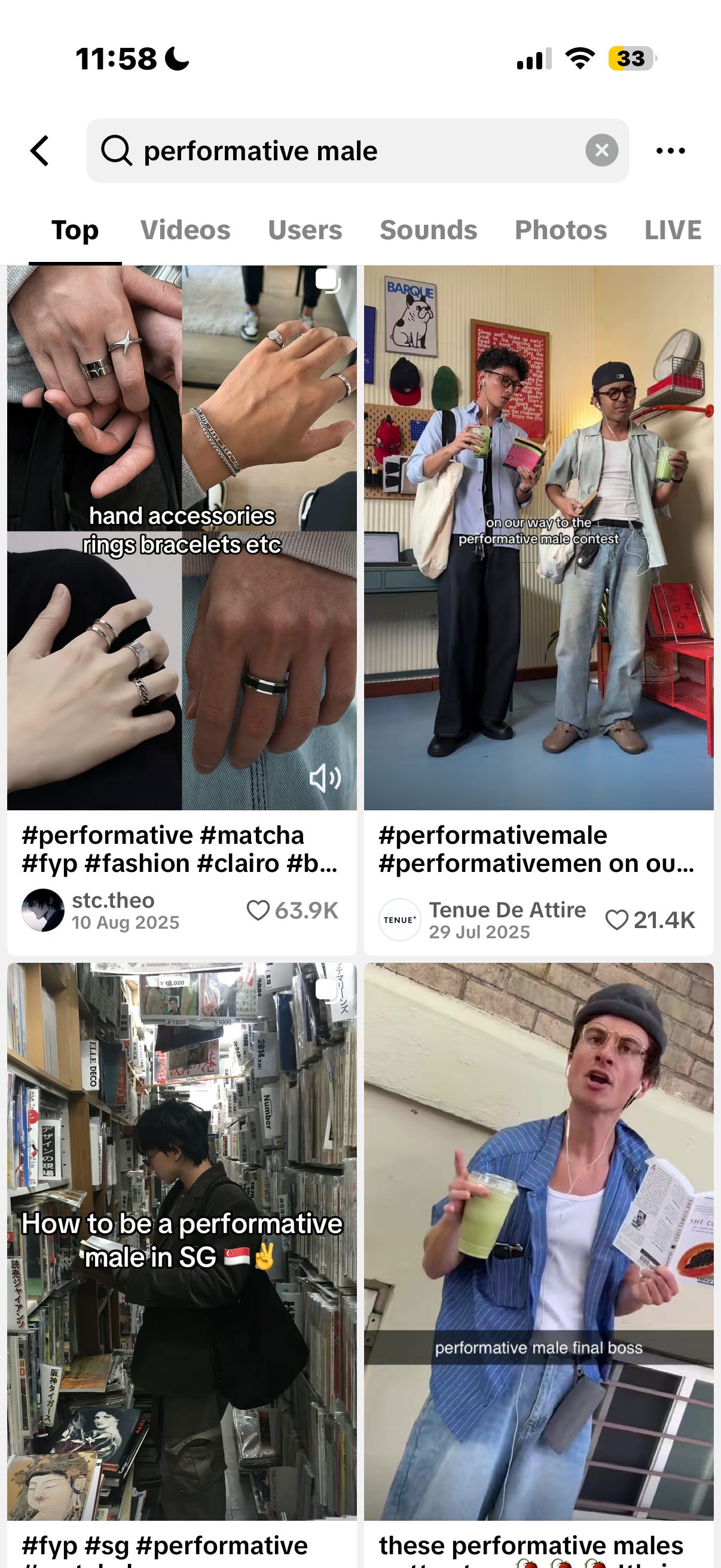
The “performative male” archetype, as defined by online critics, is a man with “traditionally feminine hobbies with the intent of cultivating an inauthentic aesthetic that might appeal to progressive women”. Because if they have a matcha in hand, cry at therapy sessions and read extensively, they must be non-threatening and… emotionally intelligent.
This phenomenon became so visible that literal competitions began springing up, maybe as a joke, or to subconsciously tuck at the ingenuine nature of these men.
But the female counterpart?
Much harder to name. Much harder to call out. And much, much harder to criticise without any social consequences. Because, it very evidently, “breaches girl code” and can easily be seen as “anti-feminist”.
The performative bisexual women. The girl who has curated playlist titled something vaguely sapphic, with tiktoks that gesture towards queerness, and photo poses that visibly suggest something more. Unlike the performative male, whose behaviour can be mocked without much moral fallout, the performative female has the comfort of sitting behind an ideological shield. One built from very real histories of women not being believed, not being allowed rights let alone sexual fluidity, not being taken seriously.
So any critique risks collateral damage.
The more the merrier right? So everyone laughs along, everyone plays into it. They let ambiguity sit unchallenged because questioning breaks the huge huge collective.
Why this probably should matter more
The consistent theme across all these cases is the same! queerness is being used as an aesthetic, a tool, or a marketing strategy by people who do not bear its costs.
What makes this hard to talk about is that the queer community has, correctly and importantly, pushed back against the idea that anyone gets to decide who is and isn’t queer, and I am sorry if I too harshly policed this. Sexuality is fluid. Coming out is a process. Nobody should have to prove their queerness to anyone. All of this is true. But it has created a situation in which the tools for identifying genuine members of a community have been effectively disabled, and in which any attempt to question whether someone’s queer identity is sincere can be painted as bigotry. This is convenient for the people doing the appropriating, and inconvenient for everyone else.
The Sabrina Carpenters of the world benefit from queer cultural capital, from the aesthetics, the community loyalty, the sense of being interesting and boundary-pushing… without bearing any of the actual weight of being a queer woman in the world. The girls flooding #wlw with content generated to capture a loyal female audience benefit from the warmth and intimacy of that community without contributing to it. The performative bisexual man benefits from appearing progressive, emotionally evolved, and safe, without any of that having to be true.
And meanwhile, actual queer people watch their spaces fill up with people who are there for the vibe, and are asked to either say nothing or be accused of gatekeeping. (Most are actually extremely welcoming, and rather unbothered. But it does keep those who are genuinely offended from speaking up)
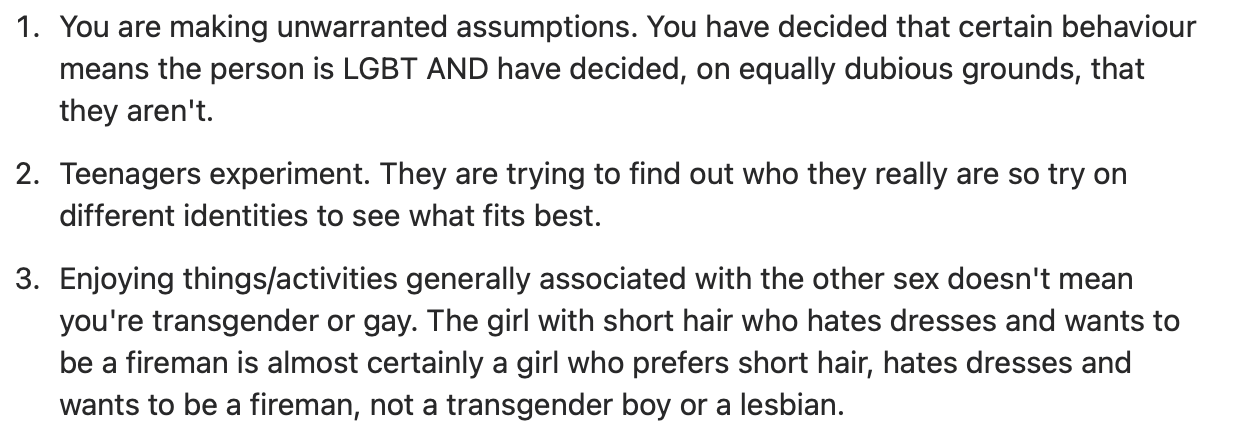

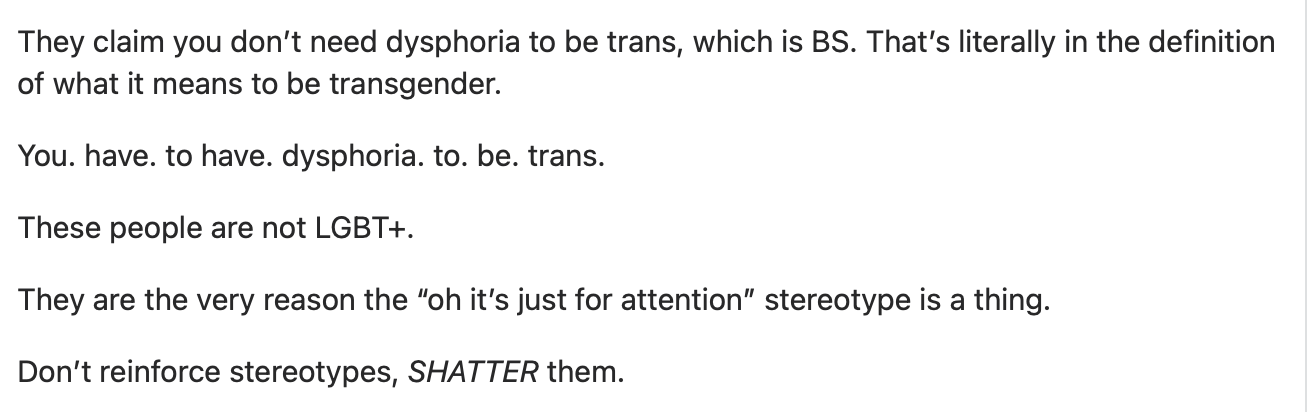
^ As seen, opinion are extremely varied, and rightfully so.
Sexuality is genuinely complicated. Online identity is genuinely fluid. Some of the people I’ve described are probably more genuinely queer than they’re given credit for. But a lot of them aren’t, and the ones who aren’t are costing the community something real. They’re costing it the ability to mean something.
I personally think queer identity is not a personality trait you can adopt because men have been disappointing lately. It is not a hashtag you append to your content because lesbian audiences are engaged and loyal. It is not a detail you add to your artist persona because it makes you more interesting to your demographic. It is, for the people it actually belongs to, the story of how they came to understand who they are, often at significant personal cost.
while i don’t think Sabrina Carpenter specifically does this,(i think Sabrina Carpenter™️ is doing drag in that she is performing exaggerated femininity) think there’s a lot of people who are essentially tourists in the gay community. like bachelorette parties in a gay club. and you’re absolutely correct that this gets messy bc there are some people who need to visit a place to see if it’s for them.
While I see and understand your point, I think that even if it’s only “queer aesthetic” that is normalised, that probably puts us queer people in a better place than we were before. Everything in our lives right now is about monetisation and branding and that’s terrible, but if in this scheme we can get spaces that are a bit safer for queer people, then so be it.